

06.19.26
Building for Today and the Future: Connectivity in Multifamily Development
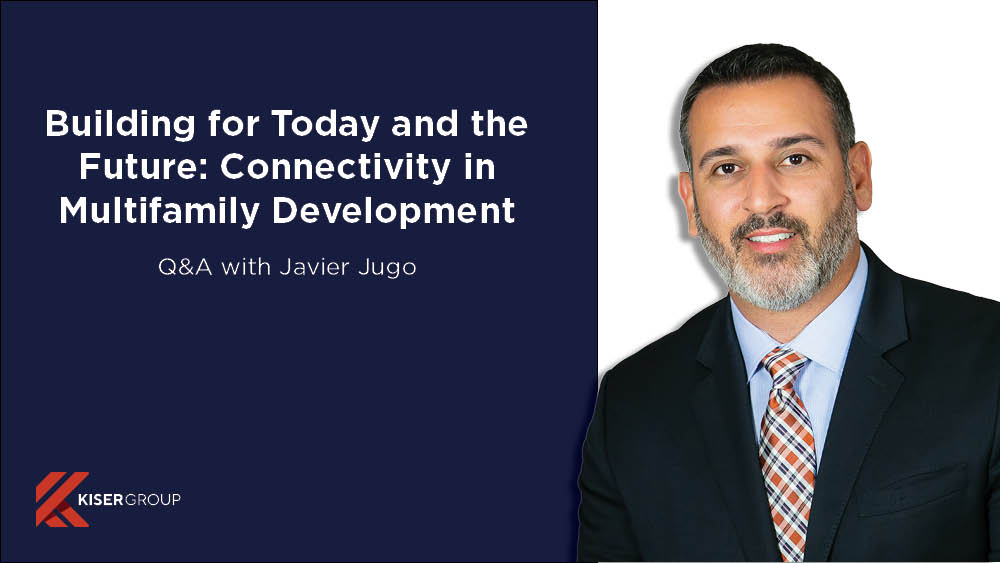
A Q&A with Javier Jugo, Comcast’s Regional Director of Xfinity Communities
Following our conversation last year on connectivity trends in multifamily real estate, we spoke again with Javier Jugo, Comcast’s Regional Director of Xfinity Communities, to take a closer look at how evolving resident expectations and connectivity trends are shaping the design and operations of multifamily properties.
Kiser Group: In our previous conversation, you talked about connectivity becoming a core part of the resident experience. How has that expectation continued to evolve?
In multifamily living, connectivity is no longer viewed as an amenity. It is now a baseline expectation. Residents want a fast, reliable and smooth internet experience: from day one, in their individual unit, and throughout the property.
In fact, recent research from Xfinity Communities and Parks Associates found that more than 40% of residents expect WiFi to be ready at move-in, and over a third want to stay connected seamlessly as they move throughout the building.
That changes the approach for property owners. Connectivity is now something that must be designed into the property and managed seamlessly to deliver on resident expectations.
Kiser Group: There’s a number of connectivity solutions for multifamily properties, but Managed WiFi is getting a lot of attention in the industry. What does that offer multifamily properties?
At its core, Managed WiFi delivers secure, always-on connectivity across units and common spaces without requiring individual equipment in every apartment.
For residents, it results in a much simpler experience. Internet is ready at move-in with no setup needed, WiFi coverage is consistent throughout the property, and devices can stay connected for everything from streaming to smart home management.
For property teams, it streamlines operations. Proactive network monitoring reduces the burden for onsite teams, connected smart building technologies such as smart locks and leak sensors enhance efficiencies, and higher resident satisfaction improves NOI.
It’s a win-win: elevating the day-to-day connectivity experience for residents, while making the property easier to manage.
Kiser Group: How should property owners think about choosing between Managed WiFi and other connectivity models like bulk Internet?
What’s most important is identifying the property’s specific needs and aligning the right solution to address them.
It starts with the end user: what is the average resident profile, what are their WiFi habits and expectations, and what kind of connectivity experience are you aiming to deliver? Assess the density of the building, the types of amenities it will offer (e.g. gyms, golf simulator rooms, roof decks), and the estimated number of connected devices.
From there, factors like building layout, network architecture and budget come into play. These are critical considerations for property connectivity, and proper planning needs to happen at the onset of a project to avoid rework down the road.
For new builds, Managed WiFi offers a property-wide connectivity experience, but for existing buildings, the infrastructure could be too challenging or costly to upgrade to Managed WiFi.
That’s where Xfinity Communities’ Connected Building solution comes in. It’s designed specifically for multifamily properties to leverage existing infrastructure – installing a Multifamily Xfinity Broadband Gateway in each unit and common areas for always-on, property-wide connectivity without the cost and disruption of a full overhaul.
We work closely with property owners from the design phase through implementation, helping them choose the solution that aligns with their building layout, their budget and their desired resident experience.
The key is having those conversations early.
Kiser Group: Office-to-apartment conversations are growing across major markets, with Chicago ranking in the top three metro areas. How does connectivity factor into those projects?
Connectivity is one of the most critical parts of a conversion project.
Office buildings weren’t designed for residential living, so you’re dealing with very different structural realities. Deep floor plates, concrete walls and long interior layouts can all impact how well a network performs.
That’s why early planning is critical. A few considerations include vertical vs. horizontal wiring, resident vs. staff networks, and in-unit vs. common area connectivity – all of which can impact network design.
These decisions will fundamentally shape the resident and staff connectivity experience, so it’s critical to get it right from the planning process.
Kiser Group: Looking ahead, what should multifamily owners and developers prioritize when it comes to connectivity strength?
Think of connectivity as the foundation of the entire property, not just an amenity.
A strong, well-designed network supports the resident experience, smart technologies, day-to-day operations, and future innovation. It becomes the backbone for how a property runs and evolves over time.
The teams that get ahead of this are the ones taking a proactive approach: understanding the resident and their expectations, assessing budget and infrastructure early, evaluating the property’s operational needs, and aligning the technology to meet all of these factors. That will set properties apart and position them for long-term success.